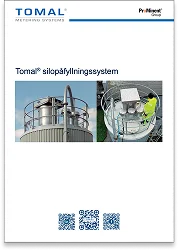

Tomal silo filling system: safe filling of silos from bulk vehicles
Tomal silo filling systems prevent risks and breakdowns when filling silos from bulk vehicles and meet today’s safety requirements – even for old and existing silos. All modern technology that Tomal uses in new silos has been designed into a compact unit for easy retrofitting on older silos. The silo owner gets fast and safe silo filling.
Why older filling systems are no longer sufficient
Other silos often have substandard systems, clogged dust filters, and pressure relief valves that are too small to handle the large airflows and high pressures involved in filling. These deficiencies cause risks for existing silos. The difference is significant: a bulk vehicle’s tank has a permissible overpressure of 2.00 bar – the silo only 0.03 bar.
As a silo owner, you are responsible for the silo’s safety and maintenance, and today’s bulk transport vehicles place high demands on the receiving silo equipment. Therefore, Tomal offers a complete silo filling system that meets today’s requirements.

Safety according to European C-standard
The system is designed so that components and functions comply with a European C-standard for silos. The C-standard is a safety standard that provides detailed safety requirements for silos and meets the requirements for CE marking.
Tomal silo filling system is delivered fully assembled, programmed, tested, and ready for installation – with simple operation for the bulk driver.
Operational advantages
Simple operation with only one start button and one stop button
Full level, overfill level, and silo pressure are continuously monitored
Automatic functional check of the silo's pressure relief valves – the driver or operating personnel do not need to climb the silo to check the status of the valves before filling
Filling is not permitted until the pressure relief valves are tested, the dust filter is started, the filling pipe's shut-off valve is open, and other parameters are approved
Included in the system
An adapter with the following equipment is mounted – without welding – in the silo’s flange for the existing dust filter:
- Dust filter, 24 m², compressed air cleaned with 7 filter cassettes, built-in compressed air tank, solenoid valves, and control box for managing the cleaning process
- Set of pressure relief valves, each with limit switches and equipment for automatic functional check – the number of valves and settings are adapted to the silo they are mounted on
- Adaptation flange for pressure relief valves, which places the valves approximately 500 mm above the dust filter flange – above the snow in winter
- Automatic functional check of the pressure relief valves, mounted on the valves’ adaptation flange
- Pressure sensor for monitoring the pressure in the silo – high pressure is indicated in the control cabinet and closes the filling pipe’s shut-off valve
- Full level switch and overfill level switch in the adapter – levels are indicated in the control cabinet, and overfilling closes the shut-off valve
- Control cabinet at the filling pipe connection/operator station, with a logic unit for silo filling, automatic functional testing of pressure relief valves, status display, and PLC LOGO for control. Start and stop buttons, flashing light, and horn are included, as well as a weather protection hood for outdoor installation. The software is delivered programmed, tested, and ready from Tomal
- Shut-off valve for the filling pipe – pneumatically controlled pinch valve, DN 100, placed on the silo’s filling pipe and controlled by fittings in the control cabinet. During installation, the existing filling pipe is cut, a new flange is welded in, and a shut-off valve with KKV coupling and flange is mounted
Technical data
Compressed air
Dry and clean compressed air, 6 bar, with 1/2″ supply line. Consumption 4.5 Nm³/h – 28 seconds between each cleaning interval, 0.2 seconds per interval. The system is connected with an 8 mm pneumatic hose at the control cabinet or on the silo roof. A multi-core compressed air hose is mounted between the control cabinet and the silo roof.
Electrical connection
The control cabinet is connected with 230 V 50 Hz, 10 A. Internal control voltage 24 VDC. A multi-core signal cable is mounted between the control cabinet and the silo roof. Signal exchange takes place via potential-free contacts – incoming: filling permitted (e.g., from control room) and extra full level signal (e.g., from an existing weighing system); outgoing: filling in progress, full level, and common alarm.
Pressure relief valves
The system is equipped with 2 or 3 pressure relief valves depending on the nature of the silo. Setting for overpressure +500 or +300 mmWC, vacuum −50 mmWC.
Frequently asked questions about silo filling
Can the system be retrofitted to an existing silo?
Yes – that is exactly what it was developed for. The adapter with dust filter, pressure relief valves, and level switches is mounted without welding in the silo’s existing dust filter flange. Only the shut-off valve requires the filling pipe to be cut and a new flange welded in.
Why can't older silos handle today's bulk transports?
Older silos often have clogged dust filters and pressure relief valves that are too small for the large airflows and high pressures involved in today’s filling. A bulk vehicle’s tank has a permissible overpressure of 2.00 bar, while the silo can only withstand 0.03 bar – therefore, the receiving equipment must be dimensioned for the task.
Does someone have to climb the silo before filling?
No. The status of the pressure relief valves is checked automatically before each filling, so neither the driver nor the operating personnel need to climb the silo.
Can the system be connected to our control system?
Yes. The control cabinet has potential-free contacts for incoming signals such as “filling permitted” from the control room and an extra full level signal from an existing weighing system, as well as outgoing signals for filling in progress, full level, and common alarm.
What is C-standard?
A European safety standard for silos with detailed safety requirements. Tomal’s silo filling system is designed so that components and functions comply with the C-standard, which also meets the requirements for CE marking.