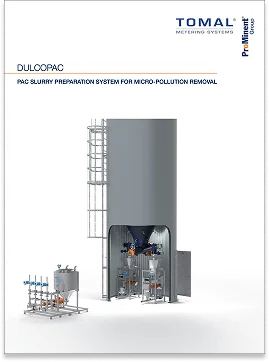
DULCOPAC: preparation and dosing of powdered activated carbon
DULCOPAC is a complete system for preparation and dosing of slurry based on powdered activated carbon (PAC). The system is designed to remove micropollutants in water treatment and is used in wastewater treatment plants, drinking water plants, and industrial facilities. DULCOPAC has a modular design with a dosing capacity of 4–400 kg PAC/h and delivers up to 10 m³ of slurry per hour to one or more injection points.
Micropollutants pass through conventional treatment
Pharmaceutical residues, pesticides, and industrial chemicals are persistent substances that conventional wastewater treatment cannot fully remove. Instead, they accumulate in waterways and natural environments, where they can cause toxic and hormonal disruptions that threaten ecosystems. Dosing powdered activated carbon in the final stage of municipal wastewater treatment plants has proven to be an effective method for eliminating these micropollutants.

Applications
Treatment of micropollutants in wastewater treatment plants
Activated carbon slurry is injected into the treatment process, where micropollutants bind to the carbon through adsorption and are separated from the water.
Drinking water treatment
In drinking water plants, the slurry is dosed in the treatment process to remove pesticides, nitrates, and organic material and to improve taste, odor, and other drinking water parameters.
Industrial water treatment
In industrial facilities, the slurry is dosed in the wastewater stream to remove organic pollutants before the water is discharged into receiving waters or reused in the process.
What is powdered activated carbon?
How DULCOPAC works
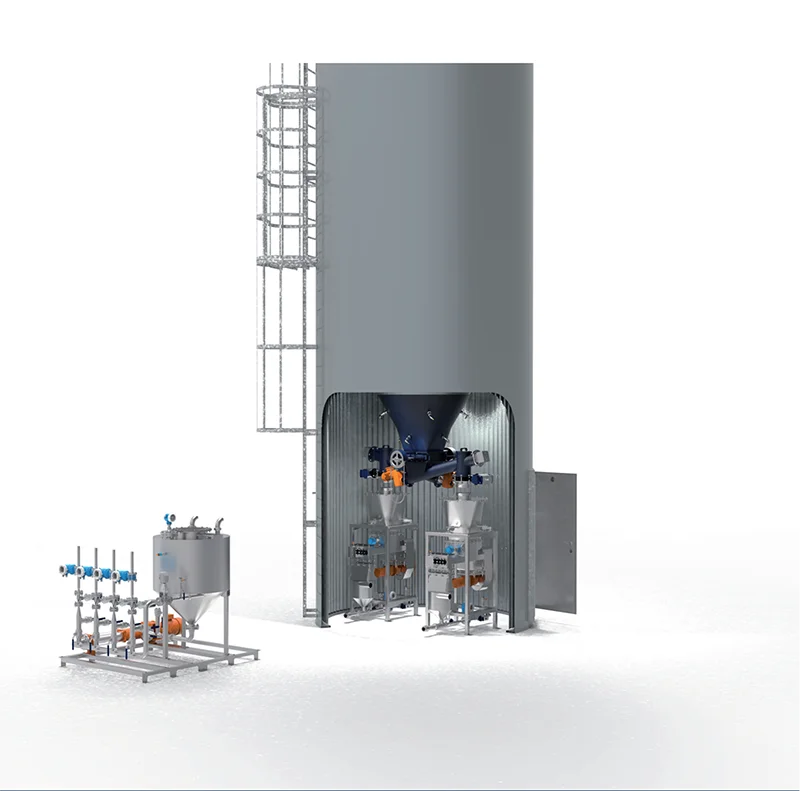
DULCOPAC consists of a gravimetric dosing system mounted under a storage silo. The carbon is fed gravimetrically to a wetting cone where it is mixed with water, then conveyed to a buffer tank and pumped from there to the dosing points.
1. Discharge from silo
At low level, the weighing hopper is filled with PAC from the silo via a discharge screw. Any bridging is broken by Tomal’s arch-breaking system, and a shut-off valve prevents more carbon from falling into the hopper after the screw has stopped.
2. Gravimetric dosing
Tomal’s unique multi-screw feeder conveys the carbon to the wetting cone. Combined with gravimetric weighing according to the loss-in-weight principle, it provides very high dosing accuracy.
3. Wetting
In the wetting cone, the carbon is fully and precisely wetted with a minimal amount of dilution water. The water flow is measured with a flow meter and the carbon quantity is controlled by the weighing system. The result is a slurry with constant concentration.
4. Buffering and distribution
The slurry is conveyed via a water ejector to the buffer tank and pumped from there in a circulation line to one or more injection points. Dosing is precisely controlled by a flow meter and control valve on a distribution unit and can be regulated based on the water flow to the contact basin.
5. Continuous recirculation
Slurry that is not dosed out is returned to the buffer tank. The constant circulation keeps the slurry in motion and minimizes the risk of sedimentation.
DULCOPAC in brief
- Turnkey system including storage silo up to 200 m³
- Modular system with dosing capacity of 4–400 kg PAC/h
- Capacity up to 10 m³ of slurry per hour to multiple injection points
- Arch-breaking system that minimizes the risk of fluidization
- Dual silo discharge for full redundancy
- High dosing accuracy through multi-screw feeder and gravimetric loss-in-weight weighing
- Supplied with control cabinet and PLC with support for multiple bus protocols—or without control cabinet for integration into existing control system
- CE-marked
Customized to your facility
DULCOPAC is supplied in single or dual configuration and the silo can be located at a distance from the distribution unit. The system is customized to the specific conditions of the facility. The delivery is turnkey and includes control cabinet, electrical installation, assembly, and commissioning.
DULCOPAC is developed by Tomal AB, a Swedish engineering company in Vessigebro, founded in 1949 and part of the ProMinent Group.
Frequently asked questions about DULCOPAC
What is PAC?
PAC stands for powdered activated carbon. It is a finely ground carbon with a very large porous surface area that binds pollutants through adsorption and is used to purify both water and air.
What pollutants are removed with activated carbon?
Persistent micropollutants such as pharmaceutical residues, pesticides, and industrial chemicals in wastewater, as well as pesticides, nitrates, and organic material that affect taste and odor in drinking water.
How is dosing accuracy ensured?
The carbon is dosed by Tomal’s multi-screw feeder combined with gravimetric weighing according to the loss-in-weight principle, and the slurry dosing is controlled by a flow meter and control valve. This provides precise dosing and a slurry with constant concentration.
How is sedimentation of the slurry prevented?
The slurry circulates continuously between the buffer tank and injection points. Because it never stands still, the risk of sedimentation in the system is minimized.
Can DULCOPAC be integrated into an existing control system?
Yes. The system is supplied with a control cabinet and PLC with support for multiple bus protocols, or completely without a control cabinet for integration into the facility’s own control system.